


Cleaning Robot

Pebble is a smart, friendly cleaning robot assistant that keeps wood
shop workstations tidy, so you can focus on creating instead of
cleaning. This new and improved robot features expressive visual cues that reflect the robot’s operational status, making interactions more intuitive and engaging. With enhanced cleaning coverage and a personality to match, Pebble is the perfect assistant for shared woodshops, ready to help tidy up after a long day of creating masterpieces.

MOODBOARD
Playful, Simple, Natural, and Friendly
I was inspired by the use of contrasting materials and playful forms from these images.

ORIGINAL PRODUCT RESEARCH
PRODUCT NAME:
Shark UR2360S Ultra Robot Vacuum
ABOUT:
-
released in late 2023 but is now in limited circulation with only refurbished ones available
-
includes matrix cleaning
-
new LiDAR technology allows precision mapping for better cleaning
-
features a self-emptying base

PAIN POINTS
UI/UX

The app had issues connecting to the robot cleaner, it took a few tries to get it to connect. Also, pressing the two buttons together was kind of a struggle.
CONTROL

It took about more two runs to clean up the mess, but it did pretty good overall. Crumbs also got stuck at the bottom of the wheels.
CLEANING UP

The Shark robot cleaner had trouble getting under the sofa because of how tall it was. It was mainly the LiDAR that got in the way.
COMPONENT ANALYSIS
BRUSH ASSEMBLY
Since the brush attachment is the most vital component of the whole project, I knew it was important to do an in-depth study. There were multiple parts that made it much more complex than I had initially imagined.
MANUFACTURING RESEARCH


The battery cover had multiple ribs to increase structure rigidity, with an emphasis on the tabs. The foam helps decrease vibration from the batteries.
Many of the parts were made by a multi piece mold.
Some had a more unique mold that opened in a spiral pattern.

EXPLODED VIEW
ENVIRONMENT RESEARCH
Because the robot I wanted to design is meant to be used a community woodshop, I did some research with the woodshop at my school as reference.


SKETCHES
I did some initial form studies before figuring out the concept and inner components.

HALF-SCALE MOCKUPS
I did some half scale models of the robot before committing to a full scale prototype. I figured out the general placement of the inner components as well as the basic aesthetic.


FULL -SCALE MOCKUPS
After figuring out the basic layout in my half-scale models, i moved onto my full-scale models, using the actual components I took out from the original robot as well as some new parts that I revised.


3D PRINTING PROCESS
I opted for tree supports because it was easy to remove but it also ended up increasing the print time by a few hours.
LID

Because it was printed in one go, there were a lot of supports on the underside.The whole print took about
26 hours.
MAIN BODY

The main body had some raise surfaces at the base of the chassi which led to an accumulation of supports. The whole print took about 37 hours
MAKING THE SCREEN
The screen was a collaboration between a friend and I where I made the screen and ux design and he helped me code the expressions.


ROBOT EMOTIONS
After about 108 solders, I was able to create a led matrix screen. This proof of concept was successful in communicating the robot's various emotions.


HAPPY/ EVERYTHING's GOOD
STANDBY/SLEEPING
BATTERY LIFE/ CHARGING
SAD/SOMETHING's WRONG
FINAL LAYOUT


INTERNAL LAYOUT
BOTTOM LAYOUT
CMF
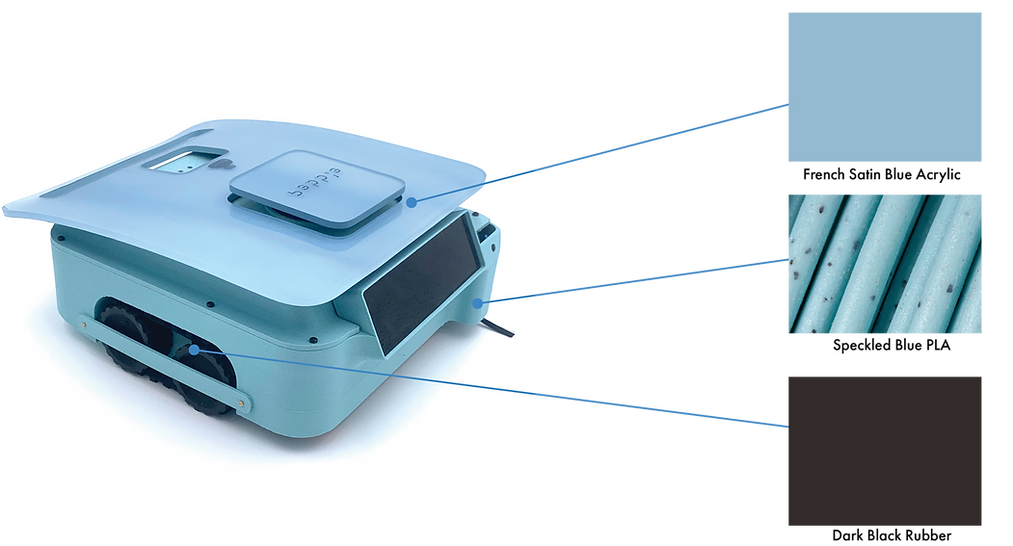
I opted for a speckled material for the body so that if the robot did get dirty in the woodshop, it wouldn't be too obvious.
FINAL


ROBOT IN ACTION
WHAT'S NEXT?
-
do more testing to see what kind of debris the robot would be able to clean
-
seeing that retractable LiDAR is a new and available technology, I would love to incorporate that into my concept
-
research sustainable materials for the robot to be mass produced in.
-
work on the docking and charging station
